> ## Documentation Index
> Fetch the complete documentation index at: https://docs.hiveku.com/llms.txt
> Use this file to discover all available pages before exploring further.
# Working a Conversation
> Take over a chat, reply or leave a note, assign, prioritize and resolve
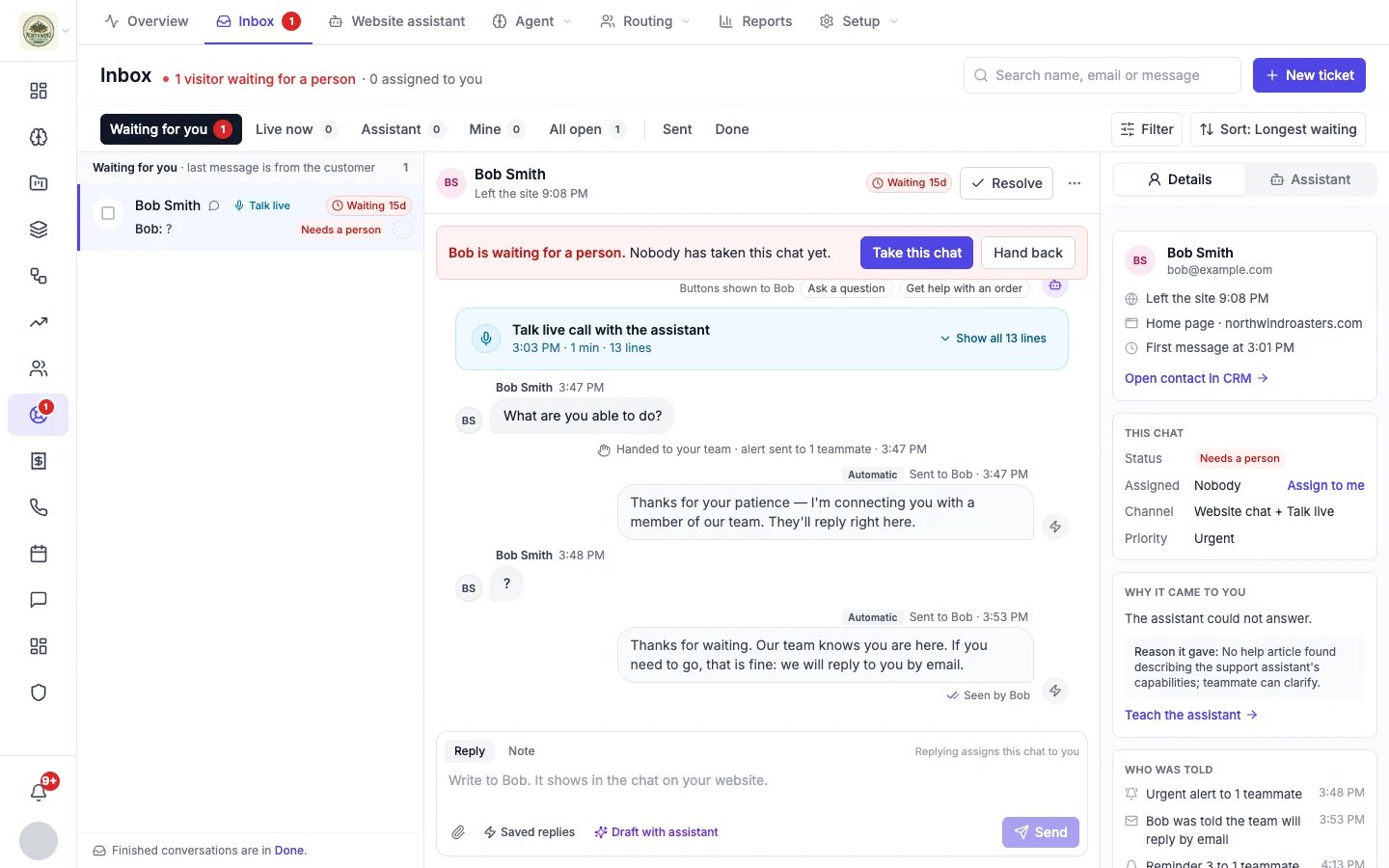
Open any conversation from the [inbox](/helpdesk/inbox) to work on it. The conversation fills the middle of the screen, and the customer's details sit on the right.
 ## Take a chat
When the website assistant passes a chat to your team, a banner says the visitor is waiting for a person:
* **Take this chat**: you answer from now on. The assistant stops replying, and the visitor sees that a teammate joined.
* **Hand back** (on the full conversation page, **Hand back to assistant**): the assistant carries on answering. It is not offered after a hand-off about a sensitive topic.
If the visitor asked for a person and nobody on your team answers within 15 minutes, the assistant takes the chat back by itself. It never takes back a chat about a sensitive topic, such as a refund or a complaint, or one it passed on because it reached its reply limit or ran out of AI credit. It tells the visitor the team will reply by email and keeps helping in the meantime, and the conversation stays in your inbox so a person still replies. The visitor can also choose **Keep chatting with the assistant** while they wait.
Replying to a chat also takes it: the reply box says "Replying assigns this chat to you".
## Reply or leave a note
The box at the bottom has two tabs:
* **Reply** goes to the customer. In a website chat it appears in the chat on your website straight away. If the visitor has left the page and gave an email address, your reply reaches them by email. On an email conversation it is sent as an email reply, and on a text conversation as a text message. On a phone conversation a reply is saved on it but not sent: call the customer back or email them.
* **Note** is private to your team. Customers never see notes. Use them to record what you checked or to hand the conversation to a colleague.
Under the box:
* **Attach** files to your reply.
* **Saved replies** inserts one of your [saved replies](/helpdesk/saved-replies). Placeholders such as the customer's first name are filled in for you.
* **Draft with assistant** asks your helpdesk AI to write a reply from the conversation. Read it and edit it before you send.
## What the thread shows
* The customer's messages, your team's replies, and the website assistant's answers.
* **Automatic** messages, such as "I'm connecting you with a member of our team", marked so you can tell them apart from your team's replies.
* A **Talk live** card when the visitor spoke to the assistant by voice. Click **Show all lines** to read the transcript.
* Events such as "Handed to your team · alert sent to 1 teammate", and **Seen by** when the visitor has read your reply.
* **Buttons shown to** the visitor, the one-tap choices they had in the chat.
## The details panel
The right-hand panel has two tabs.
**Details**:
* **The customer**: name, email address, the page they were on, when they first wrote, and **Open contact in CRM**.
* **This chat**: status, who it is assigned to (**Assign to me**), channel and priority.
* **Why it came to you**: why the assistant passed the chat on, in its own words. When it could not answer, **Teach the assistant** lets you write the answer once so it can answer the next visitor who asks.
* **Who was told**: every alert that went out about this conversation, such as an urgent alert to a teammate, the email that told the visitor the team would reply, and reminders.
**Assistant**: your helpdesk AI, which can read the conversation and draft a reply into the reply box. See [Your helpdesk agent](/helpdesk/helpdesk-agent).
## Assign, prioritize and tag
* **Assign** the conversation to yourself from the details panel or the bulk bar. To give it to a teammate, choose **More → Open full page** and pick them under **Assignee**. Automatic assignment and team queues can do this for you; see [Routing](/helpdesk/routing).
* **Priority** is Urgent, High, Normal or Low. It sets the conversation's [response time targets](/helpdesk/routing#response-time-targets).
* **Tags** are free-form labels you can filter the inbox by.
## Statuses
| Status | Meaning |
| - | - |
| **Open** | Somebody needs to act. |
| **Waiting on the customer** | You replied and are waiting for an answer (**Mark as waiting on the customer**, in the bulk bar's **More** menu). |
| **Resolved** | Done. If you turned on [satisfaction surveys](/helpdesk/satisfaction-surveys), the customer is asked how it went. If the customer writes again, by email, in the website chat or on their help page, the conversation reopens (see [Email](/helpdesk/email#replies-to-your-automatic-emails) for the replies that don't). |
| **Closed** | Finished and filed away. Resolved conversations close by themselves after a few days if you turned on **Auto-close resolved tickets**. |
Click **Resolve** at the top of a conversation when you are done. Use **Reopen** to bring a finished conversation back.
Every customer can also see and answer their conversations on their own help page, linked from your emails. See [What customers see](/helpdesk/customer-experience).
This documentation is built and hosted on [Mintlify](https://mintlify.com), a developer documentation platform.
## Take a chat
When the website assistant passes a chat to your team, a banner says the visitor is waiting for a person:
* **Take this chat**: you answer from now on. The assistant stops replying, and the visitor sees that a teammate joined.
* **Hand back** (on the full conversation page, **Hand back to assistant**): the assistant carries on answering. It is not offered after a hand-off about a sensitive topic.
If the visitor asked for a person and nobody on your team answers within 15 minutes, the assistant takes the chat back by itself. It never takes back a chat about a sensitive topic, such as a refund or a complaint, or one it passed on because it reached its reply limit or ran out of AI credit. It tells the visitor the team will reply by email and keeps helping in the meantime, and the conversation stays in your inbox so a person still replies. The visitor can also choose **Keep chatting with the assistant** while they wait.
Replying to a chat also takes it: the reply box says "Replying assigns this chat to you".
## Reply or leave a note
The box at the bottom has two tabs:
* **Reply** goes to the customer. In a website chat it appears in the chat on your website straight away. If the visitor has left the page and gave an email address, your reply reaches them by email. On an email conversation it is sent as an email reply, and on a text conversation as a text message. On a phone conversation a reply is saved on it but not sent: call the customer back or email them.
* **Note** is private to your team. Customers never see notes. Use them to record what you checked or to hand the conversation to a colleague.
Under the box:
* **Attach** files to your reply.
* **Saved replies** inserts one of your [saved replies](/helpdesk/saved-replies). Placeholders such as the customer's first name are filled in for you.
* **Draft with assistant** asks your helpdesk AI to write a reply from the conversation. Read it and edit it before you send.
## What the thread shows
* The customer's messages, your team's replies, and the website assistant's answers.
* **Automatic** messages, such as "I'm connecting you with a member of our team", marked so you can tell them apart from your team's replies.
* A **Talk live** card when the visitor spoke to the assistant by voice. Click **Show all lines** to read the transcript.
* Events such as "Handed to your team · alert sent to 1 teammate", and **Seen by** when the visitor has read your reply.
* **Buttons shown to** the visitor, the one-tap choices they had in the chat.
## The details panel
The right-hand panel has two tabs.
**Details**:
* **The customer**: name, email address, the page they were on, when they first wrote, and **Open contact in CRM**.
* **This chat**: status, who it is assigned to (**Assign to me**), channel and priority.
* **Why it came to you**: why the assistant passed the chat on, in its own words. When it could not answer, **Teach the assistant** lets you write the answer once so it can answer the next visitor who asks.
* **Who was told**: every alert that went out about this conversation, such as an urgent alert to a teammate, the email that told the visitor the team would reply, and reminders.
**Assistant**: your helpdesk AI, which can read the conversation and draft a reply into the reply box. See [Your helpdesk agent](/helpdesk/helpdesk-agent).
## Assign, prioritize and tag
* **Assign** the conversation to yourself from the details panel or the bulk bar. To give it to a teammate, choose **More → Open full page** and pick them under **Assignee**. Automatic assignment and team queues can do this for you; see [Routing](/helpdesk/routing).
* **Priority** is Urgent, High, Normal or Low. It sets the conversation's [response time targets](/helpdesk/routing#response-time-targets).
* **Tags** are free-form labels you can filter the inbox by.
## Statuses
| Status | Meaning |
| - | - |
| **Open** | Somebody needs to act. |
| **Waiting on the customer** | You replied and are waiting for an answer (**Mark as waiting on the customer**, in the bulk bar's **More** menu). |
| **Resolved** | Done. If you turned on [satisfaction surveys](/helpdesk/satisfaction-surveys), the customer is asked how it went. If the customer writes again, by email, in the website chat or on their help page, the conversation reopens (see [Email](/helpdesk/email#replies-to-your-automatic-emails) for the replies that don't). |
| **Closed** | Finished and filed away. Resolved conversations close by themselves after a few days if you turned on **Auto-close resolved tickets**. |
Click **Resolve** at the top of a conversation when you are done. Use **Reopen** to bring a finished conversation back.
Every customer can also see and answer their conversations on their own help page, linked from your emails. See [What customers see](/helpdesk/customer-experience).
This documentation is built and hosted on [Mintlify](https://mintlify.com), a developer documentation platform.