> ## Documentation Index
> Fetch the complete documentation index at: https://docs.hiveku.com/llms.txt
> Use this file to discover all available pages before exploring further.
# Helpdesk Overview
> One inbox for website chat, email, phone and text, answered by your team and your AI website assistant
Hiveku Helpdesk brings every customer conversation into one place. Website chats, support emails, phone calls and text messages arrive as conversations in a single inbox. An AI website assistant can answer visitors right away, and it hands a conversation to your team whenever a person is needed.
 ## What's included
Every conversation from every channel, sorted by who has waited longest. A red count shows how many people are waiting for you.
A chat button for your website, in your colors. Install it on any site with one line, or with one click on a site hosted on Hiveku.
AI that answers from your help articles, saved answers and website, books appointments, takes messages, and passes chats to your team.
Write an answer once. Your team inserts it in a click, and the assistant can answer with it.
Team queues, automatic assignment, and response time targets that flag late conversations.
Confirmation emails, phone and Slack alerts when someone needs a person, satisfaction surveys and auto-close.
Ask customers how it went after a conversation is resolved, and see the results in Reports.
Volume, response and resolution times, missed targets, satisfaction and how much the assistant resolved on its own.
## Channels
| Channel | How conversations arrive | How you reply |
| - | - | - |
| **Website chat** | A visitor writes in the chat on your website. | In the chat, live. If the visitor has left and gave an email address, your reply reaches them by email. |
| **Email** | Mail to a connected support inbox (Gmail or Outlook), or replies to your helpdesk emails. | By email, from your connected inbox or from your verified domain. See [Email](/helpdesk/email). |
| **Phone** | Calls your AI phone receptionist takes, messages and callback requests. See [Voice AI Agent](/communications/voice-ai-agent). | Call them back, or email them. A reply you type on a phone conversation is saved on it, not sent to the caller. |
| **Talk live** | A visitor taps **Talk live** in the website chat and talks to your assistant by voice. | The call's transcript is on the conversation; your team follows up there. |
| **Text message** | A visitor chooses to continue by text, or texts your business number while your helpdesk AI is on. See [SMS](/communications/sms). | By text from the conversation. |
## Where things are
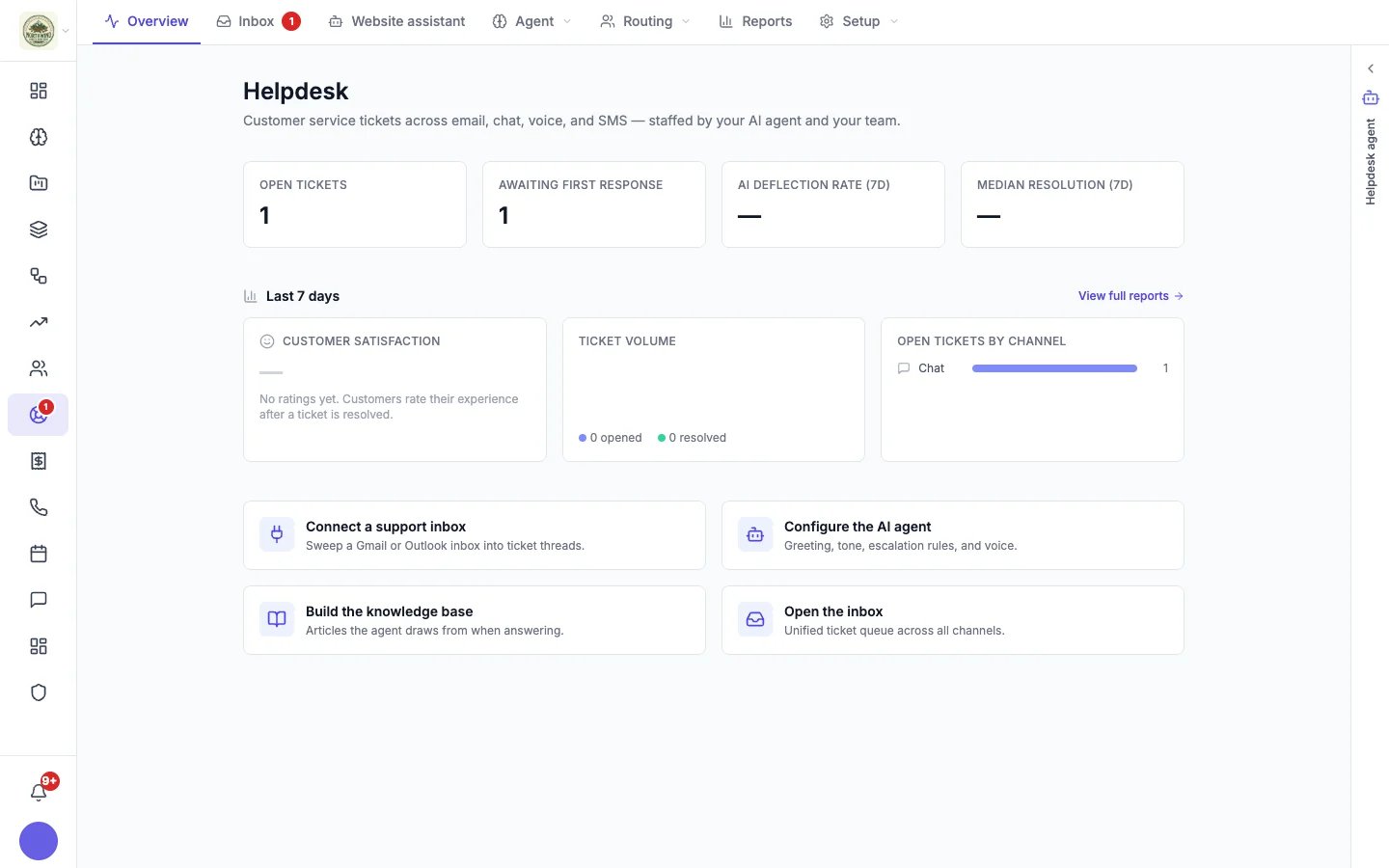
The Helpdesk menu has seven parts:
* **Overview**: open conversations, conversations awaiting a first response, the **AI deflection rate** (the share of resolved conversations never assigned to a teammate), and setup shortcuts.
* **Inbox**: every conversation. See [The inbox](/helpdesk/inbox).
* **Website assistant**: everything about the AI that answers your website chat and Talk live calls. See [Website assistant](/helpdesk/website-assistant).
* **Agent**: your helpdesk agent's **Memory**, the **Knowledge base** (help articles) and **Macros** (saved replies and saved answers).
* **Routing**: **Queues** and **SLA** (response time targets).
* **Reports**: how your support is doing. See [Reports](/helpdesk/reports).
* **Setup**: **Connections** (support inboxes), **Chat widget**, and **Settings** (automations, alerts, sending domain, blocked senders and chat history).
## Get started
Open **Helpdesk → Setup → Chat widget → Install**. On a site hosted on Hiveku, click **Add chat**. On any other site, paste the one-line snippet. See [Website chat](/helpdesk/chat-widget).
On the **Install** tab, under **How chats are answered**, choose **Support desk** (every chat becomes a ticket your team answers) or the **Website assistant** (it answers what it can and passes the rest to your team).
Write a few [help articles](/helpdesk/knowledge-base), add [saved answers](/helpdesk/saved-replies), and let it read your website. It only answers from what you give it.
When a visitor asks for a person, your team is alerted in the app, on their phones, by email, and in Slack if you turned on Slack alerts. Install the [Hiveku app](/mobile/hiveku-app) and turn on live chat alerts so a person is really there. See [Alerts](/helpdesk/alerts).
Connect the mailbox customers already write to, or send from your verified domain. See [Email](/helpdesk/email).
Confirmation emails, automatic assignment, response time targets, auto-close and satisfaction surveys are in **Setup → Settings**. See [Helpdesk settings](/helpdesk/settings).
## Your helpdesk agent
Your support department's AI agent sits in a side panel on the Helpdesk pages; in the inbox and in a website chat it is the **Assistant** tab of the open conversation instead. It is called Avery until you rename it. Ask it to triage new tickets, draft a reply, find stalled conversations or write a weekly report. See [Your helpdesk agent](/helpdesk/helpdesk-agent).
The website assistant (which talks to your visitors) and your helpdesk agent (which works with your team) are separate. Each has its own settings.
This documentation is built and hosted on [Mintlify](https://mintlify.com), a developer documentation platform.
## What's included
Every conversation from every channel, sorted by who has waited longest. A red count shows how many people are waiting for you.
A chat button for your website, in your colors. Install it on any site with one line, or with one click on a site hosted on Hiveku.
AI that answers from your help articles, saved answers and website, books appointments, takes messages, and passes chats to your team.
Write an answer once. Your team inserts it in a click, and the assistant can answer with it.
Team queues, automatic assignment, and response time targets that flag late conversations.
Confirmation emails, phone and Slack alerts when someone needs a person, satisfaction surveys and auto-close.
Ask customers how it went after a conversation is resolved, and see the results in Reports.
Volume, response and resolution times, missed targets, satisfaction and how much the assistant resolved on its own.
## Channels
| Channel | How conversations arrive | How you reply |
| - | - | - |
| **Website chat** | A visitor writes in the chat on your website. | In the chat, live. If the visitor has left and gave an email address, your reply reaches them by email. |
| **Email** | Mail to a connected support inbox (Gmail or Outlook), or replies to your helpdesk emails. | By email, from your connected inbox or from your verified domain. See [Email](/helpdesk/email). |
| **Phone** | Calls your AI phone receptionist takes, messages and callback requests. See [Voice AI Agent](/communications/voice-ai-agent). | Call them back, or email them. A reply you type on a phone conversation is saved on it, not sent to the caller. |
| **Talk live** | A visitor taps **Talk live** in the website chat and talks to your assistant by voice. | The call's transcript is on the conversation; your team follows up there. |
| **Text message** | A visitor chooses to continue by text, or texts your business number while your helpdesk AI is on. See [SMS](/communications/sms). | By text from the conversation. |
## Where things are
The Helpdesk menu has seven parts:
* **Overview**: open conversations, conversations awaiting a first response, the **AI deflection rate** (the share of resolved conversations never assigned to a teammate), and setup shortcuts.
* **Inbox**: every conversation. See [The inbox](/helpdesk/inbox).
* **Website assistant**: everything about the AI that answers your website chat and Talk live calls. See [Website assistant](/helpdesk/website-assistant).
* **Agent**: your helpdesk agent's **Memory**, the **Knowledge base** (help articles) and **Macros** (saved replies and saved answers).
* **Routing**: **Queues** and **SLA** (response time targets).
* **Reports**: how your support is doing. See [Reports](/helpdesk/reports).
* **Setup**: **Connections** (support inboxes), **Chat widget**, and **Settings** (automations, alerts, sending domain, blocked senders and chat history).
## Get started
Open **Helpdesk → Setup → Chat widget → Install**. On a site hosted on Hiveku, click **Add chat**. On any other site, paste the one-line snippet. See [Website chat](/helpdesk/chat-widget).
On the **Install** tab, under **How chats are answered**, choose **Support desk** (every chat becomes a ticket your team answers) or the **Website assistant** (it answers what it can and passes the rest to your team).
Write a few [help articles](/helpdesk/knowledge-base), add [saved answers](/helpdesk/saved-replies), and let it read your website. It only answers from what you give it.
When a visitor asks for a person, your team is alerted in the app, on their phones, by email, and in Slack if you turned on Slack alerts. Install the [Hiveku app](/mobile/hiveku-app) and turn on live chat alerts so a person is really there. See [Alerts](/helpdesk/alerts).
Connect the mailbox customers already write to, or send from your verified domain. See [Email](/helpdesk/email).
Confirmation emails, automatic assignment, response time targets, auto-close and satisfaction surveys are in **Setup → Settings**. See [Helpdesk settings](/helpdesk/settings).
## Your helpdesk agent
Your support department's AI agent sits in a side panel on the Helpdesk pages; in the inbox and in a website chat it is the **Assistant** tab of the open conversation instead. It is called Avery until you rename it. Ask it to triage new tickets, draft a reply, find stalled conversations or write a weekly report. See [Your helpdesk agent](/helpdesk/helpdesk-agent).
The website assistant (which talks to your visitors) and your helpdesk agent (which works with your team) are separate. Each has its own settings.
This documentation is built and hosted on [Mintlify](https://mintlify.com), a developer documentation platform.